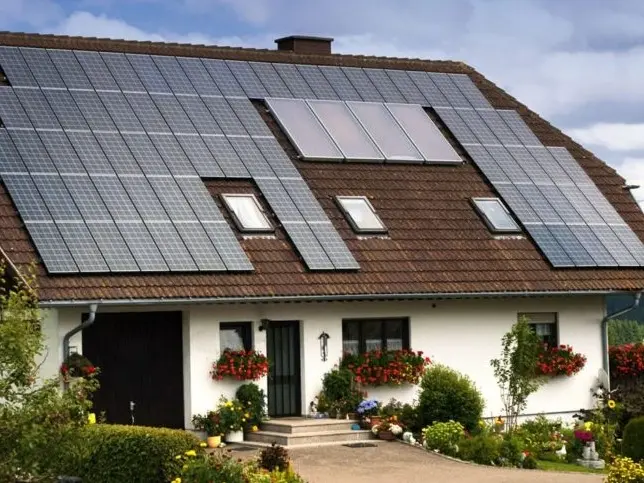
How Do Solar Panels Produce Electricity

How Do Solar Panels Produce Electricity?

Solar panels contain cells of semiconductive material, usually, silicon usually encased in a metallic frame and tempered glass. When subject to sunlight, photovoltaic cells create a flow of electric charge inside the solar panel due to the photoelectric effect.

This flow travels in a circuit of wires that connect groups of solar panels, called arrays. The solar panels feed into the inverter system. The inverter is the device that converts direct current (DC) electricity to alternating current (AC) to match the frequency of the utility grid so that it can be used to power your home!

Factors That Impact Solar Electricity Production

  • Shade
    Shaded solar panels won’t produce the same amount of energy as those in direct sunlight. If your roof is sun-deprived by un-trimmable trees or building, solar may not be your best choice.
  • Seasonality.
    Like the weather, solar energy production varies day-by-day and month-to-month. A cloudy, winter day4 won’t be as productive as a sunny, summer one. But it’s important to focus on the year-round picture. For example, snow can sometimes reflect light and improve PV performance. So in reality, a cold month will only become a solar antagonist if slush covers the panels. 
  • Tilt
    Unlike a pinball machine, solar panels can benefit from a good tilting. The direction your home is facing, its location,5 and even your roof’s pitch, have a significant effect on how well a residential solar system works. Ideally, solar panels should be at the same angle as the latitude where they’re mounted. Pitches between 30 degrees to 45 degrees usually work well in most scenarios.
  •  Azimuth
    The solar azimuth angle6 is the compass direction from where the sunlight is coming. At noon, the sun’s light comes from the south in the Northern Hemisphere and from the north in the Southern Hemisphere. The wrong azimuth angle could reduce the energy output of a solar home panel by up to 35%. An azimuth of zero (facing the equator) is usually the best choice. 

There are many panel manufacturers that build panels containing both mono and polycrystalline wafers to form solar cells


Advantages of Solar Energy


Solar power is a renewable source of energy. This is because the energy from the Sun will not run out. Fossil fuels like oil, gas and coal are not renewable. Solar power is a clean way of generating electricity. This is because it does not produce greenhouse gases which make climate change worse. It also doesn’t produce air, water or noise pollution when the panels are operating. But like almost anything we make, pollution is produced when solar panels are manufactured, set up and disposed of.

Disadvantages of Solar Energy

Solar panels generate the most electricity when the Sun is shining. They don’t work as well on cloudy days. They also work better when they are placed closer to the equator because the sun shines more directly on them, and in the summer here in the Northern hemisphere. Solar farms need a lot of land. This is land that could be used for other things like wildlife habitat or farms.

Solar panels are not very good at converting sunlight to electricity. Most solar panels are about 20% efficient. That means only 20% of the solar energy it collects is converted into electrical energy.

But even this is a big improvement on how it was only ten years ago and there is more good news on the horizon. A new solar panel has reached 47 percent efficiency in the lab and nearly 40 percent in the field. This means the future of solar electricity generation could be very bright!

Contact Us

Contact Us

SIA "SB"
444b Maskavas Street, Riga, LV-1063

Fill this form and we'll get back to you soon.